Origin point optimization: sharper,
then faster volumetric reconstruction
Fixed origin and optimized origin
A 1951 USAF resolution chart reconstructed from 9 × 9 elemental images, panels (a) and (d) of ITC-CSCC 2026 Fig. 6. Compare the edges of the bar groups.
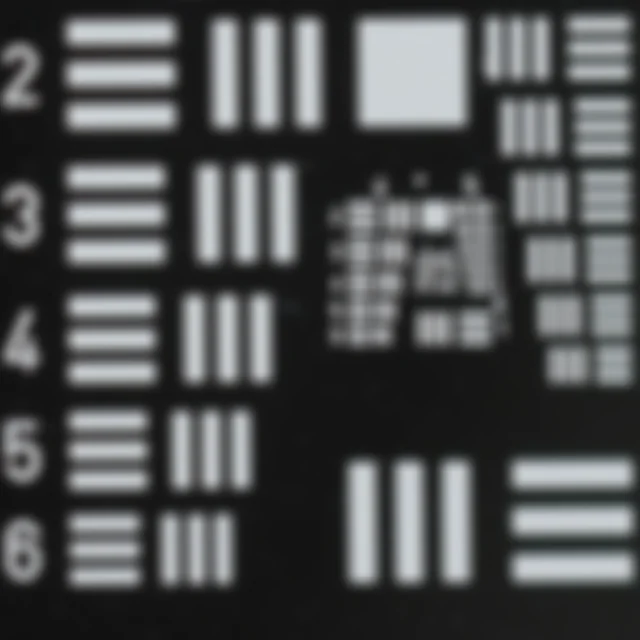
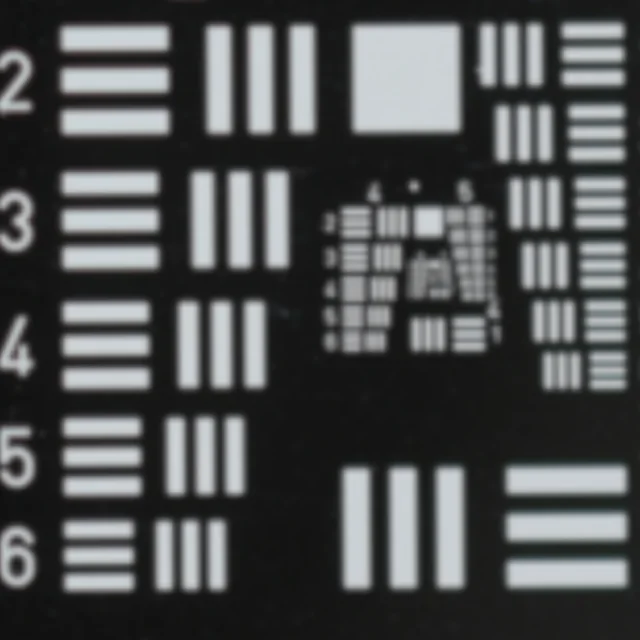 Fixed originOptimized origin
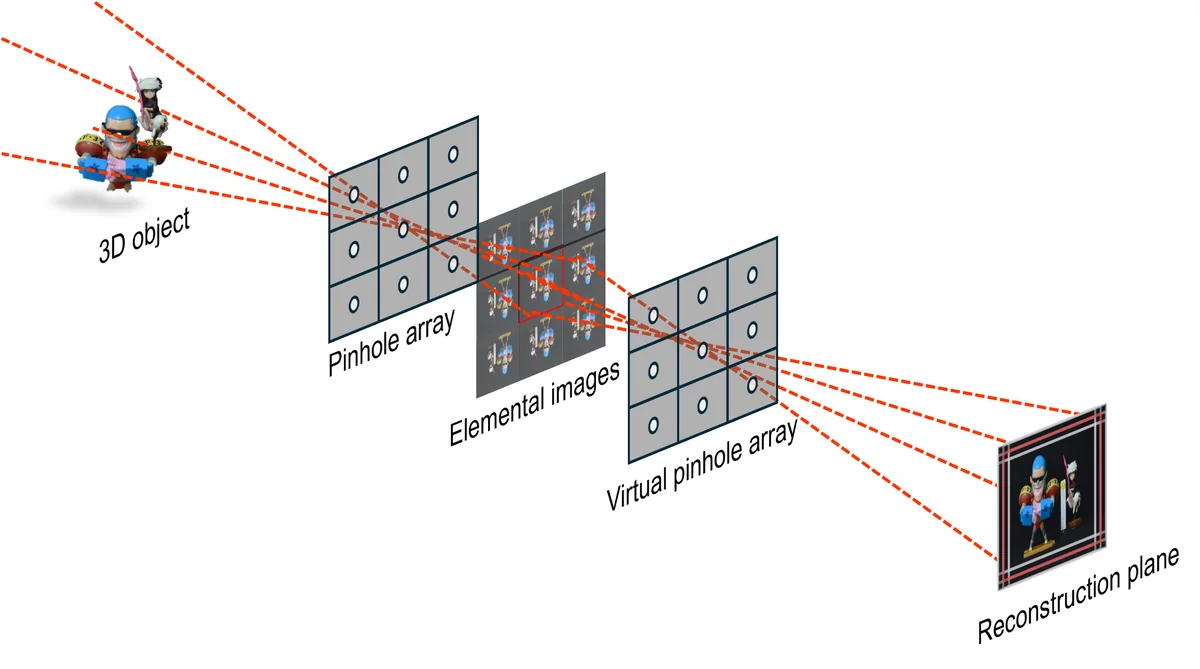
Volumetric computational reconstruction (VCR) builds slices of a 3D scene by shifting elemental images, taken from many viewpoints, by an amount that depends on depth and overlapping them. The images can only move by whole pixels, which causes quantization error and blurs the result.
The 2025 paper reduced that error by optimizing the origin point that the overlap is measured from. But finding the best origin meant reconstructing many times, which was slow.
The 2026 paper computes this origin directly from the camera parameters alone, independent of the image. In the paper's experiments it gave the same origin and the same SSIM as the iterative search, and only the time dropped. This is not guaranteed in every case.
What VCR is
Method
The loop that reconstructed once per candidate origin became one calculation from the parameters.
Before: iterative search
- Acquire elemental images
- Pick a candidate origin
- Run VCR
- Score image quality and go back to step 2
Every candidate needs a full reconstruction, so the cost is high.
Proposed: direct calculation
- Acquire elemental images
- Enter the camera parameters and depth
- Compute the origin with the smallest quantization error from a formula
- Run VCR once
Only the parameters are used, not the image, so there is no loop. In the paper's experiments, image quality (SSIM) matched the iterative search.
Run time
9 × 9 elemental images. ITC-CSCC 2026 Tables III and IV.
Code
A Python release of both papers' methods: github.com/zoocasso/origin-point-optimization-vcr
- Origin calculation (
origin.py), VCR (vcr.py), quality metrics and a timing script - 21 tests, and 10,000 seeded cases checked against the re-implemented research formula
- NumPy and OpenCV; CuPy is optional, for the GPU timing. MIT license
Cite
@inproceedings{lee2026accelerated,
  title     = {Accelerated Origin Point Optimization for
               Volumetric Computational Reconstruction},
  author    = {Lee, Hyeongju and Cho, Myungjin and Lee, Min-Chul},
  booktitle = {Proc. ITC-CSCC},
  year      = {2026}
}@inproceedings{lee2025image,
title = {Image Enhancement of Volumetric Computational
Reconstruction Using Origin Point Optimization},
author = {Lee, Hyeongju and Yeo, Gilsu and Cho, Myungjin and Lee, Min-Chul},
booktitle = {Proc. ITC-CSCC},
year = {2025}
}